Deja Vu as proof of CTF – An Observation
May 26, 2026
/
Anthony Peake
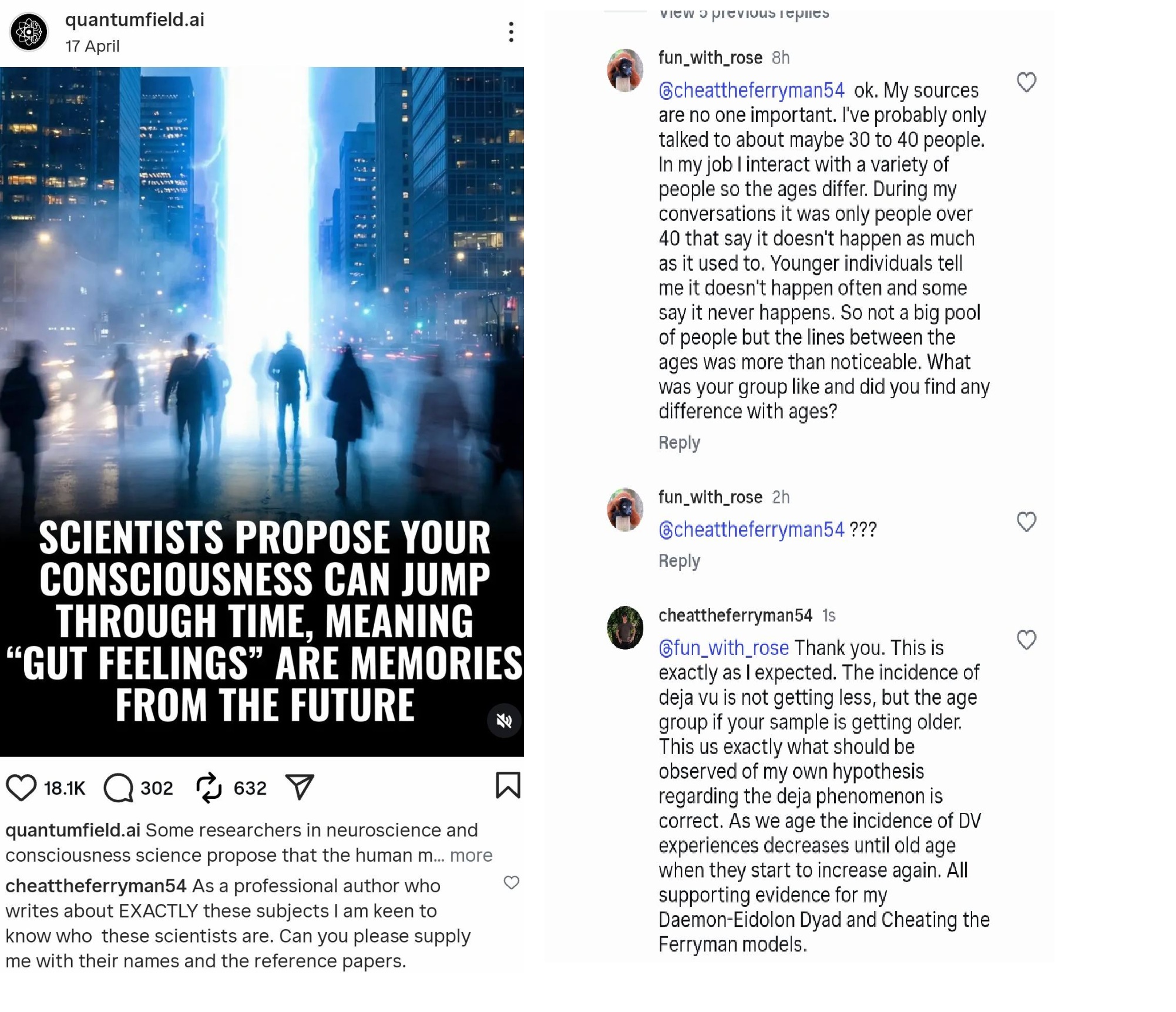
I have just had an interesting exchange of ideas with somebody over on Instagram. We were both responding to a posting by a science-based Instagram account called quantumfield.ai
I was keen to know who the “scientists” were who had allegedly proposed that ‘consciousness can jump through time, meaning “gut feelings” are memories from the future.” Of course this interested me because I would, to a degree, agree with this, but I would argue that these “memories” are facilitated by the Eidolon accessing the future memories of the Daemon (Daemonic to Eidolonic transfer via neuronal consciousness accessing glial consciousness as discussed in my book “Cheating the Ferryman”).
Unsurprisingly I did not receive a response from “quantumfield.ai” as I suspect these “scientists” don’t actually exist.
But what was interesting was a response from another instagram account who asked the question “why doesn’t déjà vu happen as much as it used to?” I was intrigued by this and asked the person what their source was.
As you can see, “fun_with_rosie” responded which can be read above. You can also read my response.
So why is this so important to me? Well one of the central supporting proofs of any scientific hypothesis is whether it is supported by research and /or observations. And the finding of fun_with_rosie in the observed reports of their contacts suggest that DV experiences decline with age. This is EXACTLY what should be observed if my CTF model is correct. As the Eidolon progresses linearly through a lifetime (within the “Bohmian IMAX”) there is more and more chance that the previous, “daemonically-perceived” memories from previous lifetimes will cease. This is simply because there will be a point where a new path within the Bohmian IMAX program will be encountered; a path never followed before. At that point all that will be experienced will be experienced for the first time by BOTH the Daemon and the Eidolon and, as such, there cannot be any “memories” to trigger a deja sensation.
Indeed, it may be of interest to readers of this posting that my hypothesis is also supported by academic research. For example check out the paper below written by Professor Alan S. Brown, one of the world’s leading experts on Déjà Vu: